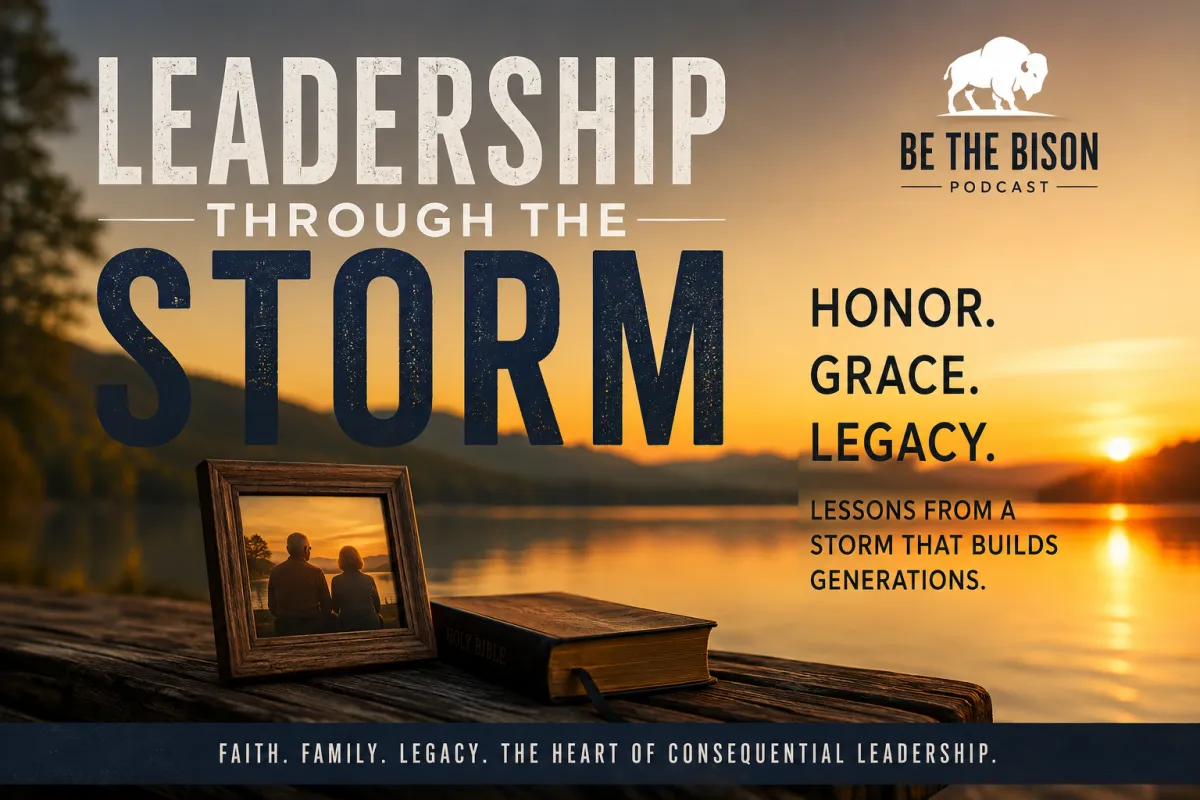
Leadership Through the Storm: Building a Lasting Legacy
What does leadership look like when there is no strategy that can fix the situation, no decision that can remove the pain, and no shortcut through the storm?
Sometimes consequential leadership happens in a boardroom. Sometimes it happens while building an organization, navigating a crisis, or making a difficult decision.
And sometimes it happens while caring for your parents.
In this deeply personal episode of Be the Bison, host Andrew Rauch steps away from a traditional interview to share his own leadership testimony—a story shaped by more than three years of caring for his aging mother, processing the earlier loss of his father, and ultimately saying goodbye to both.
Andrew's mother passed away in May following years of declining physical and mental health, including dementia. After a fall on a Monday that resulted in a broken hip, she passed away that Friday.
Her death marked the end of what Andrew describes as a nearly three-and-a-half-year storm of elder care.
It was a season filled with responsibility, uncertainty, sacrifice, grief, and moments of both sunshine and thunder.
Yet through it all, one biblical command continued to press on Andrew's heart:
"Honor your father and your mother." — Exodus 20:12
That command became more than a verse. It became a leadership compass.
Andrew's story reminds us that leadership is not merely about what we accomplish. It is about how faithfully we steward the people, responsibilities, relationships, and opportunities God places in our care.
And perhaps nowhere is that more visible than in the storms we would never choose for ourselves.
The Storm They Faced
Andrew's storm did not arrive suddenly.
It unfolded over years.
His family spent roughly three years bringing his mother to Texas, finding her a place where she could live and enjoy her remaining years, and helping her navigate the realities of aging.
Her health gradually declined. Heart issues became part of the struggle. Dementia added another layer of complexity.
Anyone who has cared for an aging parent understands that this kind of storm rarely moves in a straight line.
There are good days and difficult ones. Progress can be followed by setbacks. Roles begin to reverse as children increasingly become caregivers and decision-makers for the people who once cared for them.
Andrew felt a particular responsibility as the oldest surviving child and son.
He wanted to lead well.
His wife, Sabrina, came alongside him and became an important source of support, particularly during his mother's final days.
Then came the loss.
Years earlier, Andrew's father had died and had chosen cremation. His mother had expressed the same wishes.
After her passing, the family traveled to New York's Hudson Valley, near the Bear Mountains and Catskills—the region where Andrew's parents had last lived together.
At a beautiful lake where Andrew's nephew and his wife had married years earlier, the family gathered for a remembrance ceremony honoring both parents.
It became a moment of closure.
Not closure in the sense that grief disappears.
Rather, it represented the closing of a chapter—a long storm through which Andrew and his family had faithfully walked.
That distinction matters for leaders.
We often assume leadership means solving problems. But some circumstances cannot be solved.
They can only be stewarded.
Aging cannot be reversed. Loss cannot be negotiated away. Broken relationships cannot always be repaired exactly as we would like.
Leadership in those moments becomes less about control and more about faithfulness.
The question changes from:
How do I fix this?
to:
How do I honor God in this?
For Andrew, that became the defining question of the storm.
How They Led Through the Storm
Andrew's response to the storm reveals several principles of consequential leadership.
The first was honor.
During the family remembrance, Andrew asked a simple question:
What does God say about how we should remember our parents?
The answer began with Exodus 20:12 and the command to honor our father and mother.
But Andrew made an important distinction.
Honor does not require pretending.
Parents are imperfect people raising imperfect children in an imperfect world. Families can carry wounds, disappointments, failures, misunderstandings, and unresolved conflicts.
Biblical honor does not demand rewriting history.
Instead, Andrew described remembrance as a sacred act—an opportunity to recognize God's grace working through imperfect people.
We can give thanks for what was good.
We can acknowledge sacrifice.
We can remember lessons.
We can recognize how God used even imperfect circumstances to shape our lives.
And where wounds remain, we can choose grace.
Andrew summarized that decision in one of the episode's most memorable lines:
"We choose gratitude over resentment, grace over bitterness, and honor over regret."
That is more than advice for grieving families.
It is a consequential leadership principle.
Leaders inevitably inherit imperfections.
You inherit organizations with problems you did not create. Relationships with history you cannot erase. Decisions made before you arrived. Family dynamics formed decades earlier.
The question is whether those realities will define your future.
Grace does not erase the past.
But grace can prevent the past from controlling what comes next.
Andrew explained that extending grace does not eliminate a painful memory. Instead, it can release us from remaining tied to the burden of that struggle.
That is leadership maturity.
Move Toward What Matters
The Be the Bison philosophy comes from what bison do when storms approach.
Rather than continually running away from the storm, they move toward it and through it.
Andrew's years of caring for his mother illustrate what that looks like beyond metaphor.
Moving toward the storm sometimes means staying present when leaving would be easier.
It means accepting responsibility.
It means honoring commitments when there is little recognition for doing so.
It means choosing faithfulness over convenience.
Consequential leaders understand that courage is not always dramatic.
Sometimes courage looks like showing up again tomorrow.
Lead With Hope, Not Denial
Andrew also turned to Psalm 34:18:
"The Lord is near to the brokenhearted."
Christian hope does not require denying grief.
Scripture acknowledges sorrow while pointing us toward God's presence within it.
Andrew connected that promise with Hebrews 13:5 and God's assurance that He will never leave or forsake His people.
That creates an important distinction between optimism and biblical hope.
Optimism says circumstances will probably improve.
Biblical hope says God remains faithful even when circumstances do not unfold the way we hoped.
For leaders navigating storms, that difference matters.
Our confidence cannot depend entirely upon outcomes.
Organizations struggle.
People disappoint us.
Plans fail.
Loved ones die.
But God's faithfulness does not fluctuate with circumstances.
As Andrew expressed it, God's presence provides comfort today, His faithfulness provides strength for tomorrow, and eternal life through Christ provides lasting hope beyond loss.
Turn What You Received Into What You Leave
Andrew's message eventually moved from remembrance toward responsibility.
Proverbs 13:22 says:
"A good person leaves an inheritance for their children's children."
Legacy therefore asks a different question.
Not merely:
What did my parents leave me?
But:
What will I faithfully carry forward?
Andrew's parents were first-generation immigrants to the United States. They came from the difficult realities of World War II and post-war Europe with a desire to create a better future for their three sons.
That aspiration became part of the family's inheritance.
Andrew identified qualities worth carrying forward: perseverance, compassion, integrity, love, wisdom, and the desire to give the next generation greater opportunity.
But biblical legacy goes further.
We are called to prepare the next generation not simply to have more, but to become more faithful.
Leadership is stewardship.
Whatever God has entrusted to us—wisdom, opportunity, influence, resources, relationships, faith—we have the opportunity to multiply for those who follow.
That is the difference between accumulation and legacy.
Accumulation asks, "How much can I keep?"
Legacy asks, "What can I faithfully pass forward?"
Legacy Message
Andrew's testimony ultimately moves beyond the loss of his parents.
It becomes a challenge to everyone who leads.
The greatest way to honor those who came before us is not simply to preserve their memory.
It is to faithfully carry forward what was good.
Andrew honored his parents, Elfie and Joe, by remembering their lives. But he also recognized that their legacy would continue through the character, faith, and lives of the generations that follow them.
That is consequential leadership.
Every leader is simultaneously receiving and leaving a legacy.
We receive lessons, opportunities, sacrifices, wounds, wisdom, traditions, and examples from those who came before us.
Then we decide what happens next.
We can carry bitterness forward.
Or we can carry grace.
We can repeat unhealthy patterns.
Or we can break them.
We can consume the opportunities we inherited.
Or we can multiply them for another generation.
The storm Andrew walked through did not end because he discovered an easy answer.
He walked through it by continually returning to something deeper:
Honor God.
Honor your parents.
Receive grace.
Extend grace.
Trust God's presence.
Carry forward what is good.
Prepare those who come next.
That is what faithful leadership looks like when the storm becomes personal.
And perhaps that is one of the clearest measures of legacy: not simply whether people remember our names, but whether our faithfulness continues shaping people long after we are gone.
The storm eventually passes.
What we become while walking through it—and what we pass on because of it—can endure for generations.
Key Leadership Takeaways
Leadership is stewardship. Some problems cannot be fixed; they must be faithfully carried.
Honor does not require pretending the past was perfect. We can recognize both goodness and brokenness.
Choose gratitude over resentment. What leaders carry internally eventually influences the people they lead.
Grace breaks generational cycles. Forgiveness does not erase the past, but it can keep the past from controlling the future.
Courage often looks like presence. Moving toward the storm means continuing to show up when circumstances become difficult.
Biblical hope is rooted in God's faithfulness, not favorable circumstances.
Legacy is multiplication. Consequential leaders prepare the next generation to live, lead, and walk with God more faithfully.
Scripture Connections:
Exodus 20:12 — Honor your father and mother.
Andrew's guiding principle throughout the caregiving journey was the biblical responsibility to honor his parents.
Psalm 34:18 — God is near to the brokenhearted.
Grief is not evidence of God's absence. Scripture reminds us that He draws near in seasons of deep sorrow.
Hebrews 13:5 — God will never leave or forsake His people.
Leadership through loss requires confidence in God's presence even when circumstances cannot be changed.
Proverbs 13:22 — A good person leaves an inheritance to their children's children.
Legacy extends beyond possessions. Character, faith, wisdom, opportunity, and values can become a generational inheritance.
Call to Action
Listen to this personal episode of Be the Bison and consider your own leadership legacy:
What have you received from those who came before you—and what are you intentionally passing to those who come next?
Subscribe to Be the Bison wherever you listen to podcasts, share this episode with another leader navigating a difficult season, and visit BeTheBison.com to continue exploring what it means to become a faith-fueled, mission-driven, legacy-minded consequential leader.
