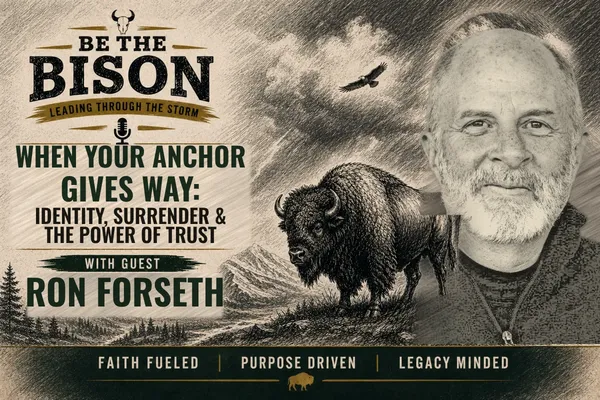
When Your Anchor Gives Way: Identity, Surrender, and the Power of Trust
When Your Anchor Gives Way: Identity, Surrender, and the Power of Trust
Be the Bison Podcast | Episode Recap
Summary
Bison don't run from the storm. They turn and walk straight into it, together, and in doing so they spend less time in it than the animals that try to outrun it. That's the heart of the Be the Bison podcast: real leaders sharing how God met them in their storms and what was waiting on the other side.
This week I sat down with Ron Forseth, a Colorado native who has lived and worked in Mexico, China, and Mongolia, served as general manager of SermonCentral.com, and co-founded ChurchLeaders.com. Today Ron is the executive producer of The Singing Bible (thesinging.bible), a project that has set every chapter of Scripture, Genesis 1 through Revelation 22, to music in 22 musical styles and two voices. That's 44 renditions of all 1,189 chapters: 52,316 recordings. In its first month, it reached more than 630,000 unique visitors from 219 countries and territories and passed six million song plays.
But the story behind the project is far more remarkable than the numbers. Ron's storm began when he was three years old, and it shaped how he learned to find, and finally where he placed, his identity.
Into the Storm
When Ron was three, his mother, Jean, was diagnosed with Lou Gehrig's disease (ALS). He watched her move from a cane, to a walker, to a wheelchair, to her bed. She lived with the disease for 23 years, close to a record, and through all of it she held on to a deep faith. She would tell Ron, "Jesus loves you, and so do I," words that made him squirm as a boy.
That early trauma left a mark. Ron describes developing an external identity, a habit of building his sense of self around the people closest to him. He remembers his first bout of depression at age six, standing in Disneyland, of all places. Even "the happiest place on earth" couldn't reach the ache.
So he searched. First, his identity rested on his dad, until that relationship grew strained. Then a high school girlfriend, whom he believed would take all the pain away. She didn't feel the same way. Then his peers.
The breaking point came at a homecoming banquet his sophomore year. Ron went to join his group of friends at their table, and they got up and ran, deliberately ditching him. Too young to drive, he found a payphone, dropped in his coins, and called his sister to come get him. "I got forsaken by the people I was defining myself around," he told me.
Something broke that night. Over the next few months Ron sank lower and lower, with nothing to hold on to, until he no longer wanted to live.
Through the Storm
One January afternoon in 1979, lying on his bed in the basement, Ron called out: "Jesus." Then he stopped and clarified. He wasn't talking to just any Jesus. He was talking to the Jesus his mother believed in.
"If you want my life, you can have it," he prayed. "But if you don't want it, I don't want it either."
It was complete surrender. He fell asleep, and when he woke, he felt compelled to pick up the Bible his mother had given him and start reading from Genesis 1. Every time he hit a question, he climbed the stairs to ask his mom, who spent her mornings in bed listening to Scripture on records and tapes. She had the answers. Down to read, up to ask, down to read again, for three straight days.
On the third day, Jean asked him, "Did something happen to you?" Ron told her he had offered Jesus his life, "and it looks like He took me up on that." From that moment, Jesus replaced his dad, his girlfriend, and his peers as the center of his identity. Ron calls Him his "shining star."
Ron is honest that his conversion didn't end his storms or his depression. There have been seasons when he relied on medication, which helped. Over the years, he has also learned to recognize a pattern: his lowest spirals trace back to moments when he'd given up on God. "All of a sudden there's no handles," he says. But when he calls on the Lord, the Lord answers.
That's why Ron chose trust as his word for 2026. He points to Job, who said, "Though he slay me, yet will I trust in him." Ron believes trust at that level deeply pleases God, and that practicing it, deliberately leaning in instead of letting go, has become one of his most powerful tools against despair.
Beyond the Storm
As Ron and I talked, a thread became clear: whatever we build our identity on will eventually be tested. A relationship. A job title. A bank balance. Put your full weight on any of those, and there's a very good chance they'll disappoint you. Ron's answer: "Absolutely. Guaranteed."
God never disappoints, even though it sometimes seems like He does. Ron says that's exactly where trust carries you through.
And then Ron shared the part of his story that made us both laugh. Not long after he came to faith, he was singing in chapel next to a girl who looked up at him and burst out laughing, not out of meanness, just honest surprise at how far off-key he was. Ron freely admits music is one of his greatest weaknesses.
Today, that same off-key singer is the executive producer of more than 52,000 Scripture songs reaching people around the world.
"God uses our weaknesses," Ron says. "When we are weak, it's His chance to show Himself strong." In his words, The Singing Bible is God's sense of humor.
The boy who once stood alone at a payphone, abandoned by the people he trusted most, now helps people in 219 countries hear the Word of God sung over them, the very Word his mother listened to from her bed and that he once read, chapter by chapter, back to life.
Key Takeaways for Leaders
Examine your anchor. Identity built on people, positions, or possessions will eventually give way. Only an identity rooted in God holds through every storm.
Surrender is a starting point, not a weakness. Ron's turning point wasn't a strategy. It was an honest, total yielding of his life.
Trust is a practice. Faith didn't make Ron's storms disappear, but choosing to lean in instead of letting go keeps him from spiraling.
Your weakness may be your calling. God often does His most visible work in the very places we feel least qualified.
Connect with Ron
Explore The Singing Bible at thesinging.bible (it's .bible, not .com). You can reach Ron at [email protected].
For more authentic stories of leaders who faced the storm, visit ventureandphilanthropy.com/bethebison and follow Be the Bison on social media.
If you or someone you love is struggling with depression or thoughts of suicide, you are not alone. In the U.S., call or text 988 to reach the Suicide & Crisis Lifeline, available 24/7.
